


 Hien Dang
The year 2025 did not close with a spectacular collapse, but with a series of quiet fractures: reassuring growth figures that no longer eased the strain of everyday life; business icons once celebrated now revealing their shadowed sides; and a society forced to place its trust under renewed scrutiny. It was a year in which Vietnam learned to doubt in order to mature, to distinguish between success as narrated and value as verified, and to recognise that development, when detached from standards and transparency, can easily turn into a collective illusion—told in beautifully polished language.
Text: MINH NGUYỄN | Image: Internet | Graphic Design: KHANG PHAM
Original Vietnamese version available here: Đọc bài viết tiếng Việt
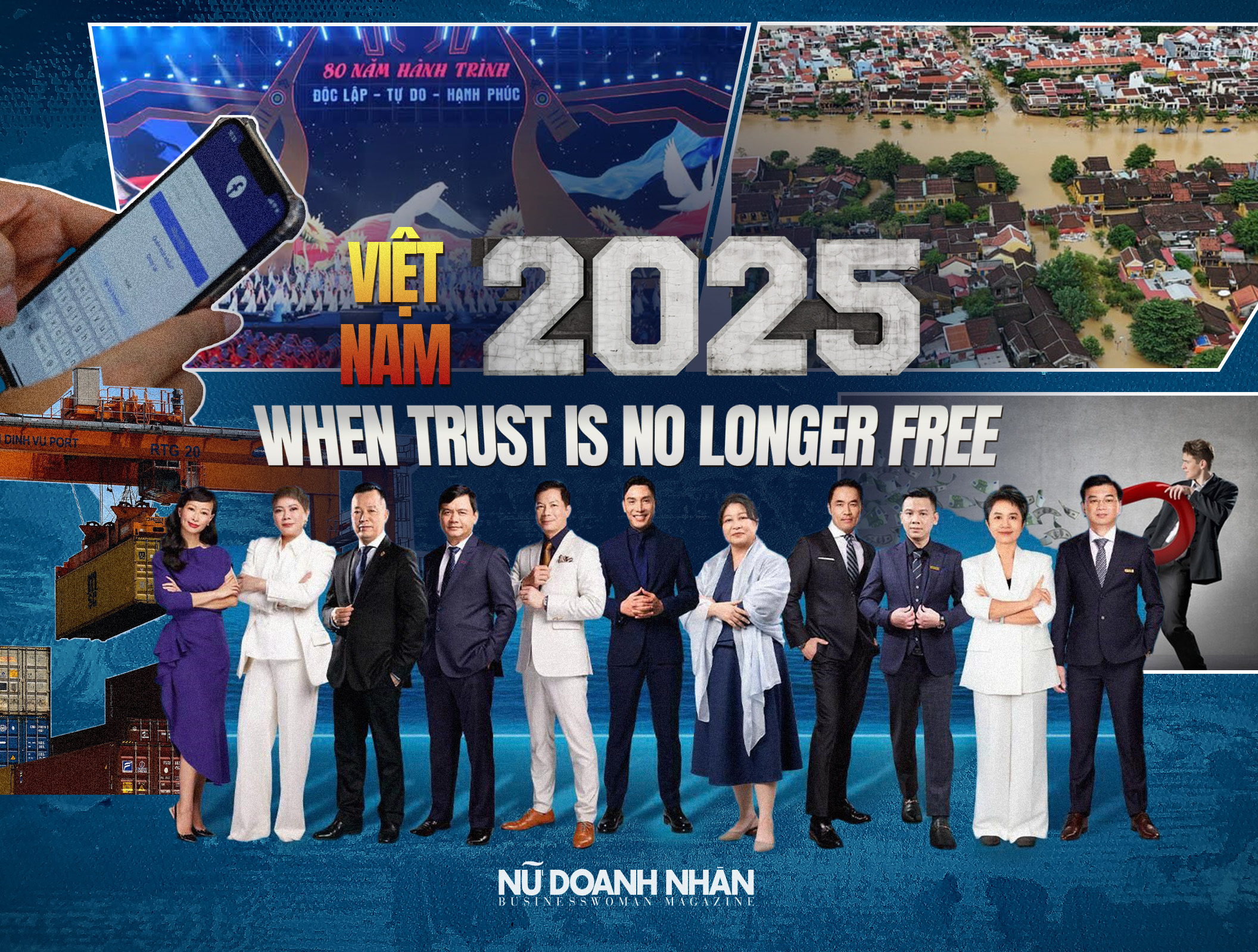
When Impressive Numbers Are No Longer Reassuring
Judging purely by official reports, 2025 was a year Vietnam could approach with confidence: robust GDP growth across consecutive quarters, new export milestones, sustained inflows of foreign investment, and a consumer market gradually regaining momentum after years of turbulence. These figures appeared with reassuring regularity in economic pages, closing speeches, and meticulously designed slides at year-end conferences, projecting an image of a growth engine running smoothly and a development trajectory firmly on track. Yet once removed from spreadsheets and confronted with lived reality, the picture shifted abruptly—slower, heavier, more abrasive, like a machine that looks flawless on paper but begins to groan when pushed continuously under harsh conditions.
According to official statistics, Vietnam’s GDP grew by 7.96 per cent in the second quarter of 2025 and 8.23 per cent in the third quarter, among the strongest performances in recent years. Behind these positive figures, however, lay a far less buoyant mood among small and medium-sized enterprises, the backbone of the economy where rising input costs outpaced profit margins, order recovery varied unevenly across sectors, and access to capital remained far more constrained than macroeconomic policies suggested. Recovery, in this sense, resembled a short blanket: pulled towards one end, it left the other exposed.
For many Vietnamese, 2025 became a year of holding on rather than advancing, of maintaining rhythm rather than breaking through. SMEs, essential yet acutely vulnerable, occupied a precarious middle ground: not collapsing, but insufficiently confident to dream big. Operating costs climbed, margins thinned, and legal risk loomed as a constant pressure, turning every expansion decision into a careful calculation. Among workers, particularly the young, pressure extended beyond performing well at work to the expectation of continual upskilling, personal brand-building, and sustained visibility on social media to avoid the sense of being left behind. Existence in modern society no longer meant simply working and earning a salary, but navigating an endless chain of KPIs, where individuals were simultaneously employees, products, and sole custodians of their own burnout.
Social Media, Public Opinion and High-Speed Judgement
The year 2025 marked a clear shift in how social media operated in Vietnam, from a space for sharing information and opinion into a high-velocity ecosystem of judgement, where public sentiment often raced far ahead of verifiable truth. A succession of controversies, from celebrity scandals and business misconduct to statements stripped of context, spread at lightning speed, while verification, investigation and legal conclusions, which require time, struggled to keep pace. The gap between what was believed and what was proven widened, and collective emotion rushed to fill it faster than facts ever could.
Throughout the year, major newspapers repeatedly warned of the phenomenon of “trial by social media”, where individuals or organisations could be condemned within hours, fuelled by thousands of comments and fragments of unverified video or imagery. In some cases, by the time official conclusions were announced, reputational and psychological damage had already become irreversible. Justice, in these instances, was not denied but overtaken outpaced by virality and algorithm-amplified outrage.
What was striking was that society in 2025 spoke incessantly about ethics, responsibility and behavioural standards, yet practised these values within an environment that privileged emotion over reason and speed over caution. Collective outrage increasingly resembled a form of consumable content: the harsher and more extreme it became, the more easily it spread; the more complex and reflective it required, the less attention it received. Media researchers observed that social platforms were transforming serious issues into public drama, where audiences judged, entertained themselves, and assumed moral superiority simultaneously.
In this context, 2025 was not merely a year of information overload, but a year in which trust was eroded by speed. When instant reaction became the norm, the slowness necessary for understanding and responsible action was dismissed as indifference or avoidance. And when society grew accustomed to judging first and apologising later, the cost extended beyond individual lives to a broader social environment in which truth increasingly struggled to reach its conclusion.
Shark Tank Vietnam Comes to a Halt: When a Startup Icon Loses Its Halo
Among the most closely watched stories in Vietnam in 2025, the official halt of Shark Tank Vietnam was not simply a television development but a symbolic shock to the startup ecosystem. In December 2025, CEO Lê Hạnh confirmed the programme’s closure after nearly a decade on air, not due to a lack of ideas or audience interest, but because trust, the very foundation of the format, no longer had the strength to sustain it. As several former “sharks” became embroiled in legal controversies or investigations involving allegations of fraud, asset misappropriation, tax evasion or financial misconduct, the image of business leaders once upheld as benchmarks of success fractured beyond repair through communication alone.
There was a time when Shark Tank Vietnam captivated millions, each televised handshake serving as a ritual affirmation of success. Investors were perceived as embodiments of commercial acumen and hard-earned experience; every funding decision doubled as a life lesson, a compass for a generation eager to move fast. When figures once representing the pinnacle of entrepreneurship began appearing in headlines under investigation or prosecution, the shock extended beyond individual wrongdoing to the collapse of a model onto which society had projected excessive expectation.
By 2025, that aura had fully reversed. The programme’s halt was no longer a backstage television matter but a public warning about the fragile boundary between curated image and operational reality. Continuous media coverage of legal developments surrounding former panelists forced the public to confront an uncomfortable question: had we believed in genuine value, or merely in a script convincing enough for prime time?
The impact resonated beyond the startup community. Shark Tank Vietnam had long been viewed as a gateway bringing entrepreneurship into the public eye, enabling projects to secure funding and inspiring young founders to take risks. When the show faded out quietly, the question ceased to be when the next season would arrive, and became whether trust had ever been placed in the right place. Its conclusion thus marked a psychological milestone in 2025, compelling society to confront the distance between televised success stories and the unforgiving realities of business behind the scenes.
Business, Law and a New Social Caution
Alongside the end of Shark Tank Vietnam, 2025 was defined by a steady stream of legal scrutiny across business, finance, real estate and banking. Investigations into financial misconduct, protracted trials involving large enterprises, project withdrawals, bank restructurings and accountability measures for executives became familiar fixtures on front pages. The phrase “with legal implications” increasingly accompanied economic news, eroding the once automatic reverence attached to success.
Society began to reassess narratives of rapid wealth accumulation, investment models promising returns far above market norms, and celebrated figures lacking long-term verification. Economic and legal analyses throughout the year emphasised transparency, risk management and regulatory compliance as prerequisites for sustainability, rather than merely applauding growth rates or asset size. Success detached from clear legal frameworks and sound governance increasingly appeared less as an aspiration than as latent risk.
Surveys and commentary cited in the press reflected a shift in public psychology: from admiration to scepticism, from belief to inquiry. Grand slogans of “getting rich quickly” lost persuasive power; glossy success stories without depth drew diminishing enthusiasm. Instead, attention turned to previously overlooked factors such as financial statements, ownership structures, corporate governance and legal responsibility. In 2025, the stage was no longer reserved for easy promises but for difficult questions: where did the money come from, what underpinned growth, and who bore the risk?
In such an environment, trust became a scarce and costly asset. Media commentary repeatedly noted that trust, once damaged by misconduct and legal ambiguity, could not be repurchased through publicity campaigns or belated apologies. Society’s newfound caution was not a sign of pessimism but of maturity—where success was measured not by speed or spectacle, but by resilience under the scrutiny of law and time.
Natural Disasters, Climate and Those Left Behind
If economics and business represented the measurable surface of 2025, natural disasters formed its unavoidable shadow where notions of growth proved fragile against nature’s weight. In late October, prolonged heavy rainfall across central Vietnam triggered severe flooding in multiple provinces, claiming dozens of lives, submerging tens of thousands of homes, severing transport links, and paralysing agriculture and tourism for days. Floodwaters swept through neighbourhoods, farmland and historic quarters, revealing losses measured not only in property but in disrupted livelihoods and the lingering insecurity that followed each rainy season.
This was not an isolated event but part of an increasingly dense pattern of extreme weather warned of by meteorological authorities earlier in the year. Reports cited by the press indicated rainfall intensity exceeding long-term averages in several areas, alongside a rising frequency of extreme events. Regions already vulnerable, such as central Vietnam, thus faced compounded risks amid limited disaster-resilience infrastructure and recovery capacity.
In 2025, climate change in Vietnam ceased to be a topic confined to conferences or scientific reports and became a daily lived experience. Salinity intrusion in the Mekong Delta, extreme floods in the central provinces, and prolonged heatwaves in major cities were repeatedly documented as tangible manifestations of a shifting climate. While urban centres discussed digital transformation, smart cities and green growth, many localities remained preoccupied with safeguarding homes, fields and roads after each disaster.
The divide between fast-growing cities and climate-vulnerable regions grew more pronounced, not only in damage severity but in recovery speed. Economic hubs mobilised resources swiftly, while rural and coastal communities required months or even years to return to normalcy.
Thus, 2025 delivered an uncomfortable reminder: economic growth divorced from serious investment in climate resilience and social protection risks creating pockets left behind within the same nation. While GDP figures continued to be updated quarterly, the costs of natural disasters—from livelihoods and education to mental health, remained difficult to quantify and slow to repair.
Algorithms, Memory, and the Confusion of Value
The year 2025 exposed a structural confusion in how the content industry defines cultural value. Algorithm-driven “hits” continued to be optimised for immediate reactions: capturing attention quickly, provoking controversy at scale, and sustaining engagement across short life cycles. They were measured with precision, reported exhaustively, and distributed efficiently, yet most left little that endured in collective memory. Their success, ultimately, was the success of distribution systems rather than of the content itself.
By contrast, programmes rooted in national identity when executed with artistic discipline and contemporary thinking, revealed a different kind of appeal: harder to quantify, yet more durable. They did not peak through speed, nor spread through conflict, but generated sustained attention and deeper engagement. This is not a paradox. It is a sign that algorithms can measure reflexes but not meaning; amplify emotion but not replace memory.
The problem in 2025 was not that light or entertaining content gained ground, but that the entire media ecosystem increasingly equated noise with cultural value. When reaction becomes the central metric, what requires time to understand is pushed aside; when shareability is prioritised over retention, depth is treated as an unnecessary cost. Within this structure, culture is gradually handled like a short-term consumer good: designed for rapid use, quick replacement, and easy forgetting.
The reality of 2025 suggests that audiences are not rejecting depth; they are growing sceptical of what is presented as “success” yet fails the test of time. As the difference between what is widely viewed and what is truly memorable becomes clearer, confidence in familiar metrics begins to waver. From that wobble emerges a new reflex: society slows its trust, asks more questions, and approaches smoothly packaged values with greater caution.
Seen this way, 2025 did not merely close a content cycle; it opened a new cognitive state. When what is amplified is no longer assumed to be what is trustworthy, scepticism ceases to be a destructive stance and becomes a necessary condition for maturity.
A Society Learning to Doubt in Order to Grow
Looking back on 2025, the most significant development lay not in repeatedly cited growth figures or headline-dominating events, but in a subtle yet fundamental shift in how Vietnamese society allocated trust. Across economic forums, everyday conversations and year-end commentaries, enthusiasm for flawlessly narrated success stories waned. Audiences grew less susceptible to optimistic rhetoric and more inclined to question the foundations beneath celebrated symbols. Doubt, in this context, ceased to be destructive and emerged as a protective reflex of a society learning to mature.
This shift resulted not from a single shock but from accumulated experiences throughout the year: a once-iconic startup show halting amid a trust crisis; prolonged business and financial cases shadowing the concept of “successful entrepreneur” with legal uncertainty; social-media controversies where today’s idol could be dismantled with tomorrow’s click. Together, these experiences crystallised a new awareness: between narrated image and verified value lay a gap society no longer wished to ignore.
Analyses of information-consumption behaviour in 2025 indicated a clear rise in public caution. Audiences increasingly cross-checked sources, traced data and questioned transparency rather than placing unconditional trust in singular voices or polished narratives. Questions shifted from “who said this?” to “on what basis?”; from outcomes alone to processes, structures and accountability. Concepts once deemed dry—verification, accountability, business ethics—surfaced more frequently in social commentary, signalling a raised collective standard, albeit at the cost of diminished enthusiasm.
This was not solely a Vietnamese phenomenon, but part of a broader global context in which trust in information and success archetypes faced mounting pressure. In an era of data saturation, societies worldwide slowed their belief, becoming more selective and cautious about what passed as self-evident truth. Vietnam moved within this current, compelled to rebuild trust amid an increasingly complex information environment.
As legacy symbols, from startup shows to business and media celebrities wavered, society was forced to redefine success itself. Achievement without transparency no longer merited admiration; reputation alone failed to shield against accountability; and trust, once eroded, proved irreparable through messaging or belated apologies.
Viewed positively, the spread of doubt in 2025 signalled not a crisis of trust, but a necessary stage of maturity. When trust ceased to be freely granted, it demanded construction through time, transparency and genuine responsibility. In learning to doubt, Vietnamese society gained an opportunity to enter a more grounded, less illusion-driven phase—where value resided not in acclaim, but in endurance under the scrutiny of reality and time. If one were to name the deepest spirit of 2025, it might not be instability, but the moment society realised that well-timed doubt does not weaken trust—it makes it less fragile.
Entering 2026: When Standards Matter More Than Symbols
As Vietnam steps into 2026, what it may need is not more symbols to admire, but firmer standards to measure by; not more success stories told quickly and beautifully, but development models patient enough to withstand time, transparent enough to endure scrutiny, and responsible enough not to collapse once the lights dim. A mature society does not gauge its vitality by the number of idols it elevates each year, but by its willingness to question the values it celebrates.
After a year marked by friction, the most profound lesson of 2025 lies not in determining who was right or wrong, nor which event resonated loudest, but in recognising that trust can no longer be consumed like a media product. Trust eroded by unverified promises, curated images and hollow achievements leaves voids that cannot be easily filled. In those voids, society is forced to slow down and learn to doubt, not to deny all value, but to discern what deserves preservation.
2025 closed as a trial by fire for trust, exposing cracks in unstable structures, dimming halos unsupported by standards, and exacting the price of collective illusions through belated awakening. Yet those very cracks, if confronted honestly, may form the foundation of something sturdier—less flamboyant, less rhetorical, but more resilient.
Entering 2026, what is worth hoping for is not a “better year” in simplistic terms, but a more demanding one: demanding of promises, of role models, of success stories told too quickly. When society insists on standards over symbols, transparency over emotion, and responsibility over spectacle, this is not pessimism but the signal of necessary growth.
And if one must name the spirit of the coming year, it is perhaps not optimism or exhilaration, but clarity: clarity that distinguishes noise from value, fame from credibility, growth from progress. A society clear-headed enough may move more slowly and cautiously, but is also less likely to lose its way. And perhaps that is precisely what Vietnam needs after a year that forced it to reconsider so many assumptions once thought unquestionable.

Read more: