

 Hien Dang
In the early days of 2026, Vietnamese social media once again found itself caught in a familiar vortex: a well-known artist embroiled in controversy over the way she responded to audiences on a digital platform. The phrase “Lệ Quyên swearing and clapping back at audiences” quickly flooded online spaces, from Facebook and Threads to countless showbiz discussion groups. What stood out was not the speed of its spread, already a defining feature of social media but the immediacy of public reaction: polarisation, anger, defence, and condemnation, all unfolding almost simultaneously.
Text: MINH NGUYỄN
Original Vietnamese version available here: Đọc bài viết tiếng Việt
Yet if the story stops at judging whether a single remark was right or wrong, something far more significant is missed. Behind one brief online “clash” lies a broader issue: the culture of conduct expected of public figures in the age of social media, where the boundary between the private individual and the public image has become more fragile than ever.
From a minor comment to a public storm
According to circulating accounts, the incident began with an English comment posted under a Threads update from an account believed to belong to Lệ Quyên. The use of slang open to multiple interpretations, sparked debate. What truly triggered public backlash was not the original comment itself, but the subsequent response: sharp, direct, and perceived as falling outside the standards audiences typically expect from a veteran artist.
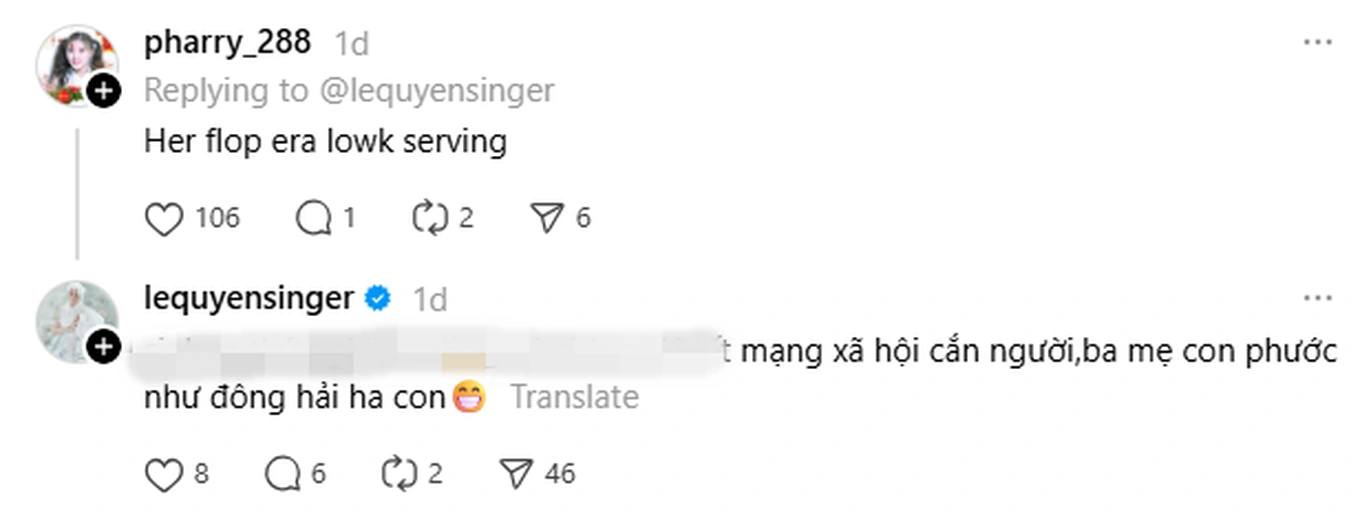
From the opposite perspective, the singer argued that she had been subjected to prolonged attacks, that what the public saw was merely a fragment stripped of context, and that her reaction stemmed from psychological pressure rather than disdain for audiences. Two viewpoints collided. Neither side was entirely wrong, yet neither emerged victorious. It is precisely at this point that the narrative moved beyond the actions of one individual.
Social media and the illusion of “replying to just one person”
One of the greatest traps of social media is the illusion of intimacy. When replying to a comment, celebrities often feel as though they are addressing a single account. In reality, they are making a public statement before tens or hundreds of thousands and potentially millions if the algorithm decides to amplify it.
Offline, artists are surrounded by protective layers: the stage, scripts, managers, and production teams. Online, those buffers almost disappear. A smartphone, a moment of irritation, an unfiltered line of text, any of these can become evidence, screenshotted, edited, and circulated at uncontrollable speed.

Algorithms are indifferent to context or goodwill; they thrive on conflict. Calm explanations rarely travel far. A sharp “clap back” almost always does. Within that spiral, public figures can easily slip past the line of propriety before realising they have crossed it.
“I’m only human”, a valid argument, but an incomplete one
The most common defence for celebrities in such situations is simple: they are only human. That is undeniably true. Public figures experience exhaustion, hurt, and the instinct to push back. Yet fame is a particular profession, one in which the right to react is inseparable from the cost to one’s image.
An ordinary person might swear in frustration, noticed by only a handful of people. When a celebrity does the same, it instantly becomes part of their public record. Audiences do not judge only the sentence itself; they judge the character behind it. And once trust is chipped away, it is extraordinarily difficult to restore with explanations alone.

Vietnamese showbiz has seen this pattern repeatedly. Transgender beauty queen Hương Giang faced backlash after confronting anti-fans in a highly charged manner, eventually issuing an apology when her approach was widely seen as crossing a line. Over the years, Đàm Vĩnh Hưng has also been drawn into multiple online verbal battles, each reopening cycles of controversy that gradually eroded his public image. What these stories share is not personality, but a stark reality: personal emotion rarely outweighs collective perception.
Looking beyond Vietnam: a global phenomenon
On a global scale, the issue is even more pronounced. Doja Cat shocked her fandom after publicly criticising fans, rejecting the fandom name, and accusing supporters of “imagining a relationship”. From a rational standpoint, she was not wrong, artists do not owe fans personal affection. Emotionally, however, the fallout was severe: fan pages shut down, her image suffered, and a worldwide debate erupted over parasocial relationships between artists and audiences.
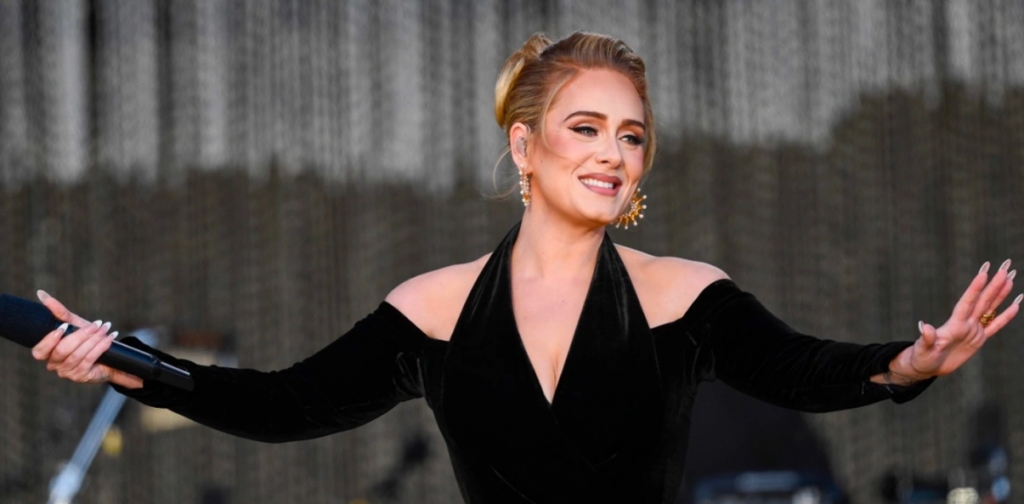
Conversely, other cases demonstrate that the key difference lies in the direction of the response. Adele once openly reprimanded a concertgoer for a discriminatory remark during a Las Vegas show. Her response was firm but focused on behaviour and values, not on personal attacks. The result was broad public support, with many viewings it as a defence of standards rather than a personal clash. These contrasts underline a crucial point: not every reaction is wrong but how one reacts matters profoundly.
The thin line between rebuttal and insult
Online, the line between rebuttal and insult is so thin that a single misplaced phrase can flip public opinion. Audiences may accept artists defending their views, but they struggle to tolerate language that belittles others.
Once a celebrity crosses that boundary, a troubling question emerges: Was this a momentary lapse, or a glimpse of true character? And once that question takes hold, every subsequent explanation faces an uphill battle.
It is no coincidence that Vietnam has introduced codes of conduct for both artists and social media users. Though largely non-punitive, these guidelines reflect a clear social expectation: the greater one’s influence, the greater one’s responsibility in speech and behaviour.
When silence becomes strategy, not weakness
One paradox of the digital age is that quick responses are often praised as strength, while silence is dismissed as avoidance. In practice, communication history shows the opposite. Many personal crises involving public figures escalated simply because a response was issued before emotions had settled.

In certain situations, silence is not surrender; it is a refusal to play by the rules of conflict. Not every comment requires a reply. Not every provocation is worth a reputational scar that may last for years.
Responsibility does not rest solely with celebrities
It would be unfair to place the entire moral burden on artists. Toxic online environments do not arise spontaneously; they are cultivated through the consumption of drama, collective excitement over verbal clashes, and the unchecked sharing of sensational fragments.
When a heated reply is circulated tens of thousands of times, the question must be reversed: are we criticising, or are we enabling? The conduct of public figures cannot be separated from the conduct of the public. The more audiences relish takedowns, the more celebrities are pushed into emotionally defensive positions.
Words online are a contract of image
The controversy surrounding Lệ Quyên, regardless of how public opinion ultimately settles, leaves behind a sobering but necessary lesson. For public figures, every line posted online is a contract of image. It is signed with emotion, but paid for with credibility. One may believe they are addressing a stranger, but in reality they are speaking to the public, to their personal brand, and to the history of their career.

In an era where everyone holds a microphone and every platform is a stage, standards are no longer moral accessories, they are survival skills. And sometimes, the greatest value a public figure possesses lies not in talent or fame, but in the ability not to let a moment of anger turn them into the centre of a story that never needed to exist.

Có thể bạn quan tâm: