


 Hien Dang
The cancellation of the concert “Về đây bốn cánh chim trời” (Return Here, Four Birds of the Open Sky) just hours before its scheduled performance after tickets had been widely sold and thousands of audience members attracted, quickly moved beyond the scope of a routine organisational failure. When the legal representative of the organising entity was subsequently prosecuted, the incident became a stringent test of how Vietnam’s live entertainment market manages business risk, legal exposure, and cash flow. From a business perspective, this is no longer an emotional story, but a structural one.
Text: MINH NGUYỄN | Image: Internet
Original Vietnamese version available here: Đọc bài viết tiếng Việt
A Performance Project That Was Sold, but Never Fully Risk-Scoped
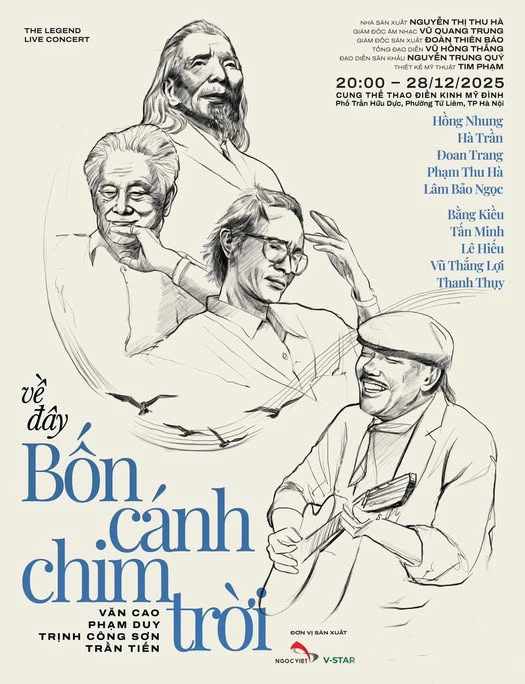
“Về đây bốn cánh chim trời” was announced as a large-scale artistic concert, centred on canonical works by four major figures in Vietnamese music: Văn Cao, Phạm Duy, Trịnh Công Sơn, and Trần Tiến. The programme was conceived as a concert-format production, featuring a symphonic orchestra and a large band, alongside the participation of numerous singers and artists associated with the classical and lyrical tradition. According to its initial presentation, this was not a conventional entertainment show, but a musical project requiring long-term preparation, new arrangements, and complex collective rehearsals.
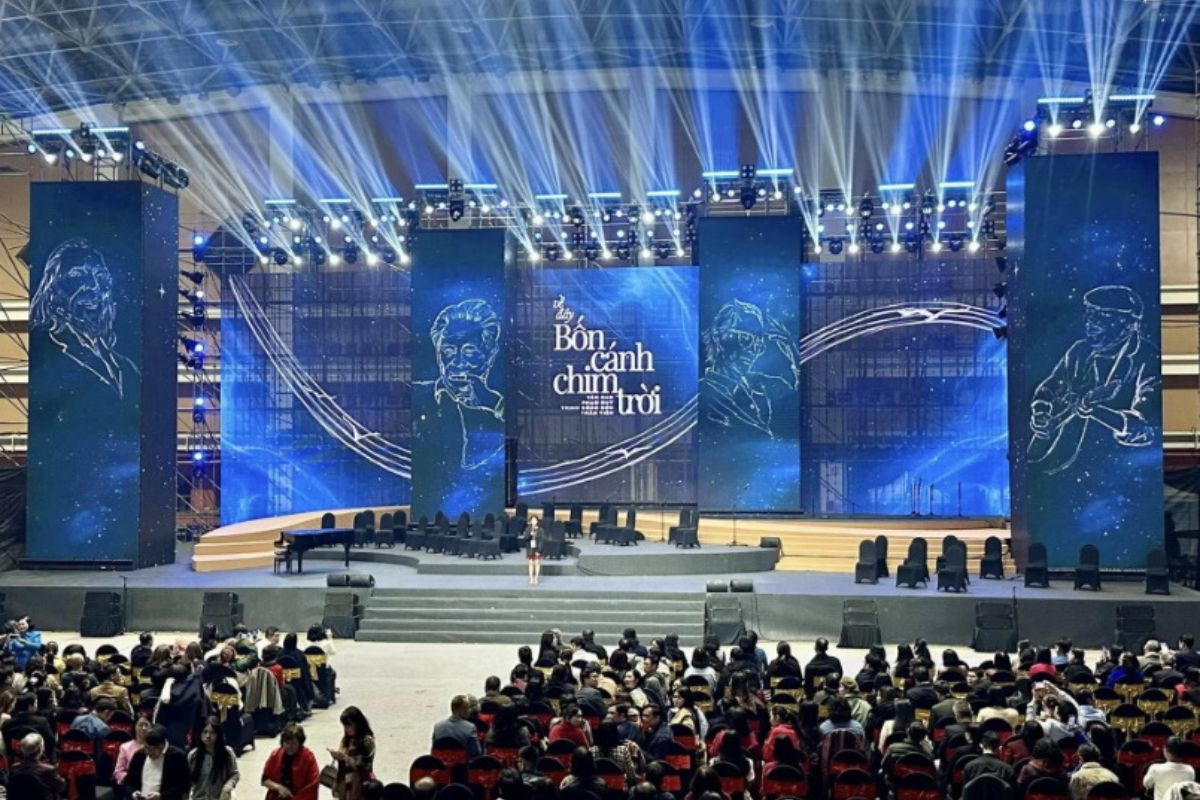
Tickets were released to the public at multiple price tiers, targeting an audience segment with higher age demographics and spending capacity. In the lead-up to the performance date, many attendees proactively arranged their personal schedules, booked flights and hotels, and travelled from other provinces and even from abroad to Hà Nội to attend. This demonstrated that the programme was not merely positioned as a music event, but was received by the market as an experience whose scale and quality had already been implicitly guaranteed.
Accumulating Risks as the Performance Date Approached
However, as the performance date drew nearer, several core elements of the project began to show simultaneous signs of strain. From a financial standpoint, the payment schedule between the organiser and the music production team failed to reach alignment with the original commitments, causing preparation to be disrupted and prolonged in a state of uncertainty. At the same time, a number of works included in the programme encountered copyright issues, prompting requests from rights management bodies to suspend their use and thereby creating direct legal risks for the content of the performance.
From an operational perspective, the preparation timeline was steadily compressed, while the programme’s structure, featuring a large orchestra, multiple participating artists, and newly commissioned arrangements, remained unchanged. This significantly increased execution pressure during the final days, which are typically the most sensitive phase of any large-scale live performance project. Despite the clear emergence of these risk signals, ticket sales continued until very close to the scheduled showtime, widening the gap between market commitments and actual deliverability.
In project management terms, this was the stage at which organisers were expected to make difficult but necessary decisions: to pause, postpone, or restructure the programme. When that did not happen, risk did not disappear, it merely accumulated, only to erupt at the moment when damage would be greatest.
When a Business Failure Escalates into Legal Risk
Not every cancelled show results in criminal liability. In practice, many live performances in Vietnam have been postponed or cancelled for objective reasons and resolved through civil measures such as refunds or compensation.
The critical issue in this case lies in the timing and manner of ticket sales. When investigators raise the question of whether the organiser knew the programme could not be delivered as planned yet continued to collect money from the public, the nature of the incident changes fundamentally. The element of “awareness of risk without disclosure” moves the case beyond the realm of ordinary business failure into a different legal threshold.
For event-organising enterprises, this serves as a stark warning. The boundary between civil liability and criminal responsibility does not hinge on whether a project incurs losses, but on the degree of transparency and honesty maintained with the market at each stage of execution.
Ticket Revenue and the Governance Vacuum
One of the most significant weaknesses in Vietnam’s live entertainment market lies in how ticket revenue is managed. Typically, ticket proceeds are transferred directly into the organiser’s operating account and quickly used to cover production and operational costs. When a programme encounters difficulties, these funds are already dispersed and extremely difficult to recover in full within a short timeframe.
In the case of “Về đây bốn cánh chim trời”, refunding audiences became a major issue not only because of the volume of tickets sold, but because ticket revenue was never placed within an independent protective mechanism from the outset. As a result, a financial risk rapidly translated into a legal one.

At its core, this is not the failure of a single individual, but the consequence of a market structure lacking a clear “firewall” between customer funds and an enterprise’s operating cash flow.
Artists and Production Teams: Consequences of an Incomplete Structure
Following the cancellation, public debate focused heavily on the decisions of artists and the music production team. Yet from a legal standpoint, artists are not the legal entities selling tickets, nor are they the parties controlling audience cash flow.
In a fully developed operating system, artists’ responsibilities are limited to professional and creative quality, while legal and financial accountability rests with the organiser. When the system is insufficiently robust, these roles become blurred, and public pressure tends to fall on the most visible individuals rather than on the structural weaknesses that require correction. This does little to address the root problem and instead highlights the absence of a framework capable of clearly allocating responsibility from the outset.

Reference Points from International Markets
In more developed live entertainment markets, show cancellations are not uncommon, yet they rarely escalate into social or legal crises. The difference lies in risk governance structures.
In 2017, Adele was forced to cancel part of her tour due to health issues. Thanks to event insurance systems and independent ticket revenue management mechanisms, audiences were refunded promptly, and organisers were not pushed into extreme legal exposure. Risk was treated as a business matter, not a moral one.
Similarly, during Taylor Swift’s European tour, three concerts in Vienna were cancelled due to security concerns. Despite the large volume of tickets sold, refunds were automatically activated through ticketing systems and insurance coverage. Market confidence remained intact, artists were not subjected to public controversy, and the tour continued at other venues.

These cases illustrate that the key difference lies not in goodwill, but in the existence of risk-protection structures.
The Structural Challenge Facing Vietnam’s Live Entertainment Market
If the response stops at identifying who should bear responsibility for a single programme, the market will miss an opportunity for self-correction. This incident exposes the lack of fundamental tools for risk management in Vietnam’s live entertainment sector: independent ticket escrow mechanisms, event insurance, requirements to demonstrate financial capacity when applying for performance licences, and efficient civil dispute resolution channels.
In the absence of these tools, any major incident risks exceeding the boundaries of business failure and becoming a serious legal issue, creating a chilling effect across the entire market.
The concert “Về đây bốn cánh chim trời” did not take place, but it left behind a clear lesson on how a still-maturing market confronts risk. A creative economy cannot develop sustainably if it continues to operate primarily on personal trust and goodwill.
Only when risk is governed by structure, trust is underpinned by clear legal mechanisms, and audience funds are genuinely protected can Vietnam’s live entertainment market move into a more mature phase—one in which a cancelled performance no longer triggers consequences beyond reasonable control.
| Legal Timeline of the concert “Về đây bốn cánh chim trời” Before the performance date: The programme was widely promoted; tickets were sold publicly across multiple price tiers. Close to the performance date: Issues emerged regarding payment schedules with the music production team and copyright-related constraints. On the performance date: The programme was cancelled at the last minute, after audiences had already arrived at the venue. After the cancellation: Intense public debate arose concerning the responsibilities of the parties involved. Late December 2025: Investigative authorities-initiated prosecution and temporary detention of the legal representative of the organising entity on allegations of fraud and misappropriation of property. |

Read more: